Bukhara

The journey from Khiva to Bukhara was a long six hour train journey across the desert. Despite most of the journey passing arid desert, we occasionally came across farming villages, which were once collective farms during the Soviet era. Unlike farming in most European countries, the fields were mostly cultivated by the hand of labourers. They were all heavily covered to avoid heavy sun exposure and a number of the workers waved at the passing train. The train was almost a Central Asian answer to the Hogwarts Express, with compartments and a man bringing jugs of green tea round the car.
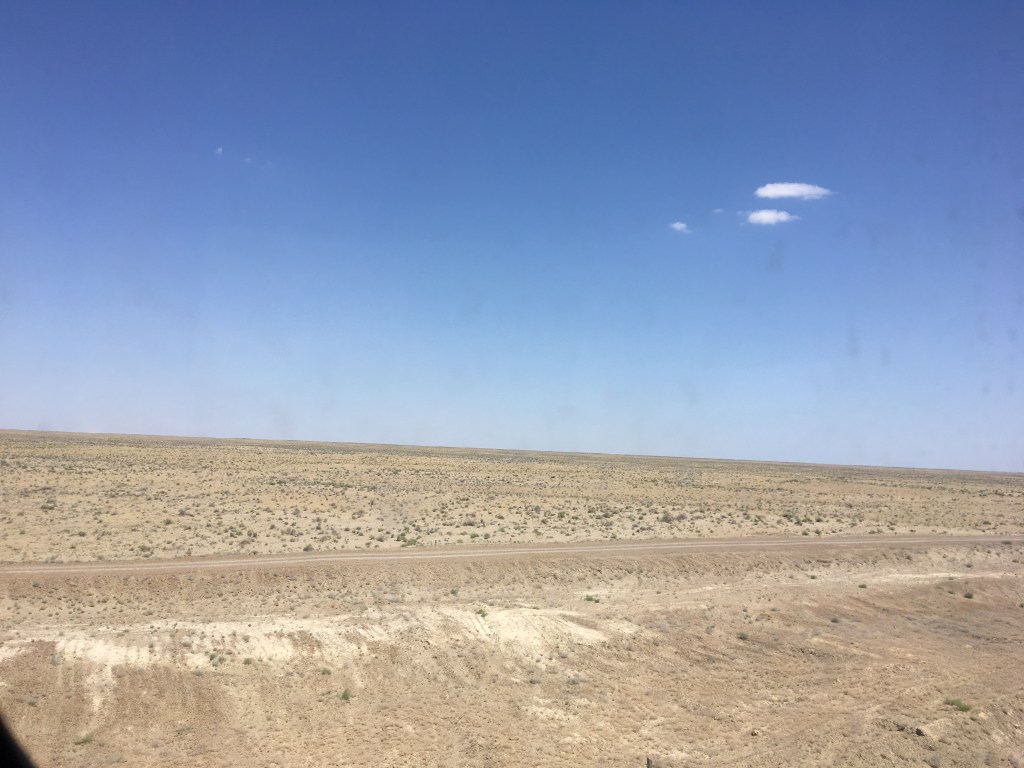
The view from the train

Once we arrived in Bukhara, we immediately got a sense of the local heat. Bukhara is renowned for being one off the hottest places in Uzbekistan and temperatures can hit 50ºC in the the summer. However, Bukhara has a large pond in the city centre with cafés which serve Coke Zero, a very rare commodity in Central Asia!
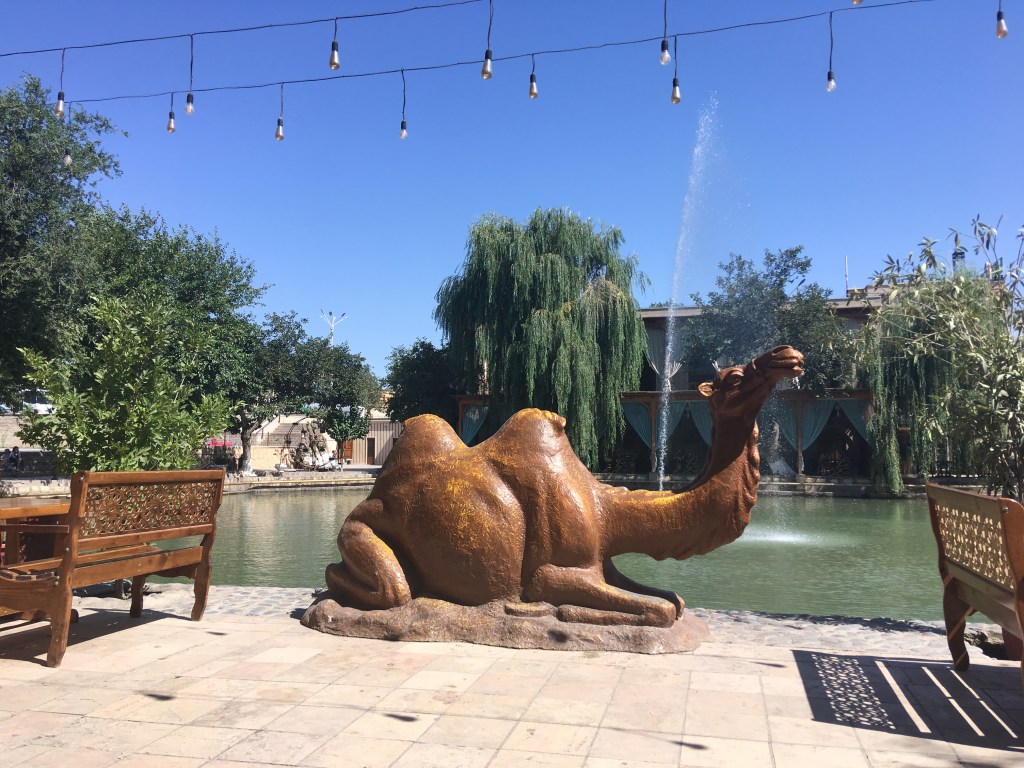
The Lyab-i-Hauz pond

Bukhara is also well-known for its minority communities. Bukhara is home to a large number of Tajik people. Unlike the Uzbeks, the Tajiks are related to the Persians of Iran and the Tajik Language is very similar to Farsi, with the main difference being the scripts, with Tajik using Cyrillic script and Farsi using Arabic script. Bukhara As well as the Tajik people themselves, Bukhara’s Jewish population also speak Tajik. Although most of the population now live in Israel and the United States, Bukhara still has a Jewish quarter with an old synagogue.

Bukhara’s Tajik Persian past is still visible today, an obvious example being the Samanid Mausoleum in the North-West of the city. Although the mausoleum is Islamic, it has been built in the design of a Zoroastrian fire temple, the pre-Islamic religion of Ancient Persia. The mausoleum was complete with elaborate carvings throughout the temple, including the windows.
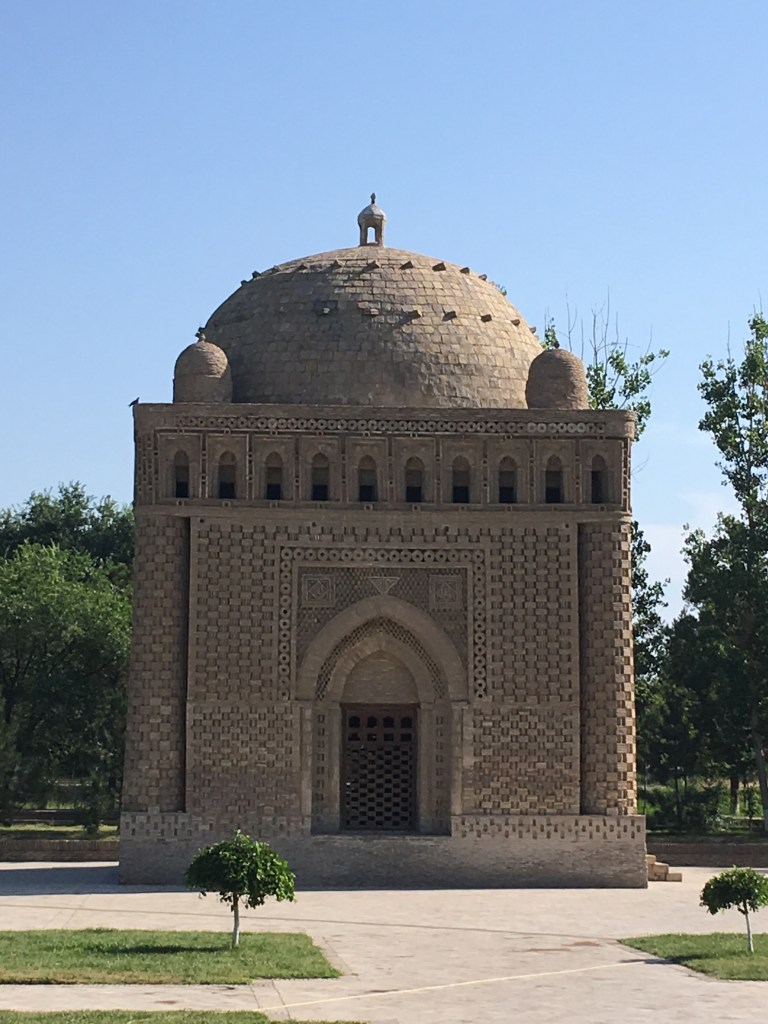
Saminid Mausoleum

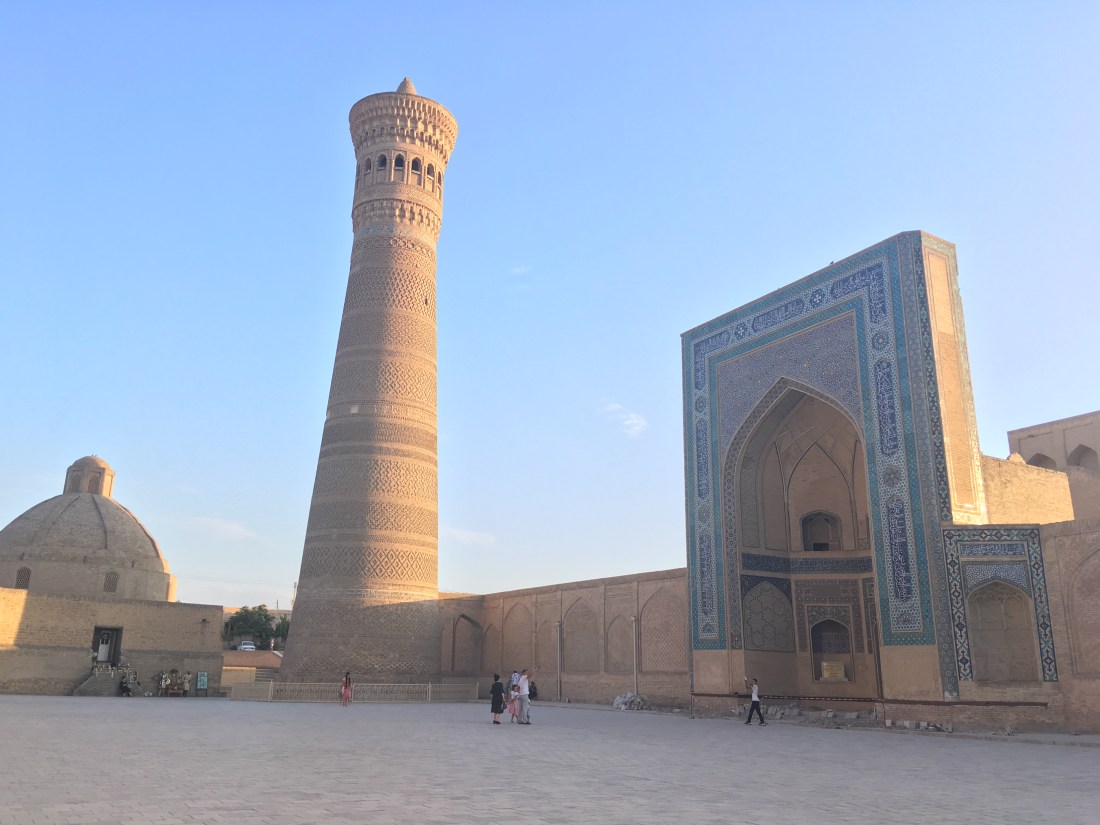
The main landmark of Bukhara without a doubt is the Kalyan minaret. The minaret was used not only to call Muslims to prayer, but also as a lookout post to warn if an attack on the city was imminent. As well as its towering statue, the engravings and calligraphy on the minaret are ornate.
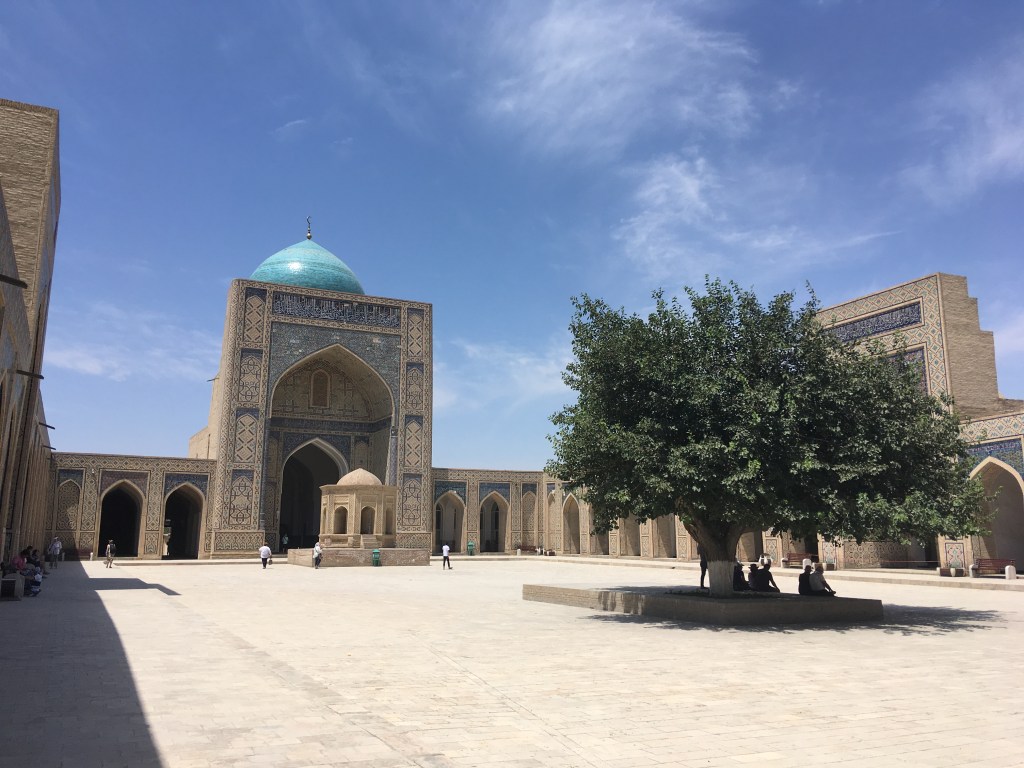
Courtyard at the Kalon Mosque

Bukhara is also renowned for its production of rugs, particularly those with Turkmen patterns. Our guide brought us to a family-run rug factory that was located not far from the Kalyan complex to allow us to explore the different types of rugs made and how they were produced. The production of the rugs is extremely painstaking, with the workforce being made of young girls. This is due to the fineness of the patterns and due to the workers’ hands becoming bigger with age, weaving the rugs becomes much more difficult. Rugs can take anywhere between a few months to years, depending on the size of the rug and the workers use images to work out where each knot should be placed. Although these rugs are expensive, it is not difficult to see why considering the dexterity, ornateness and artistic nature of their production.

One memory I have of Bukhara is when I needed to go the pharmacy, due to a wisdom tooth coming through. As I had nothing with me that would help, I decided to brave it and go to the pharmacy, known as ‘Dorixona’ in Uzbek (one of the few Uzbek words I remember) and ‘Аптека’ (Aptyeka) in Russian. Luckily, my Russian phrasebook that I brought with me had a health section in it, so decided to ask the person over the counter in broken Russian for some teething gel. Luckily, an elderly Russian ‘babushka’ knew what I was asking for and helped the man behind the counter and I ended up with a tube of Russian teething gel. The gel worked wonders and I was fine the next morning! It also gave me huge confidence to speak more Russian throughout the trip.
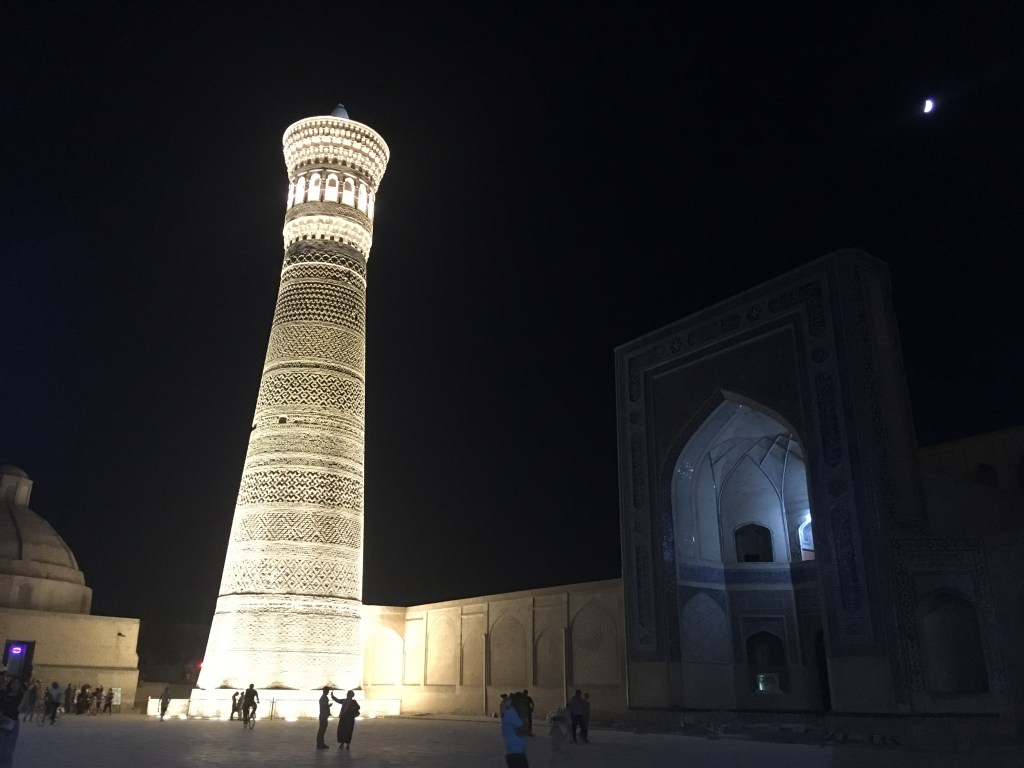
Kalyan Mosque and Minaret seen at night

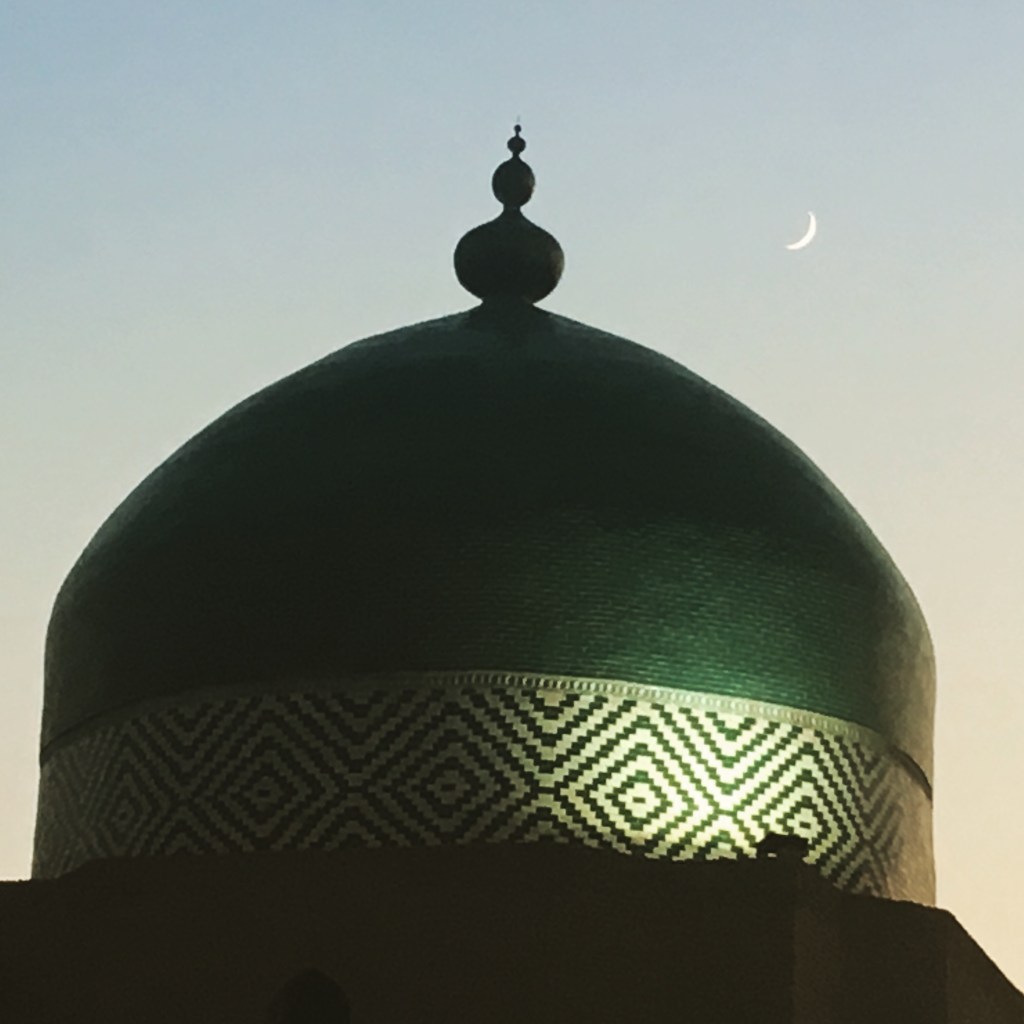
On the way to the station to catch the train to Samarkand, we had time to see the Char Minar Madrasah. The name ‘Char Minar’ means ‘four minarets’ in Persian/Tajik and the building resembles a mosque. Although the minarets are not used and cannot be accessed, it is possible to go onto the roof and explore the motifs of the minarets and dome, some of which resemble Zoroastrian, Buddhist and Christian designs.
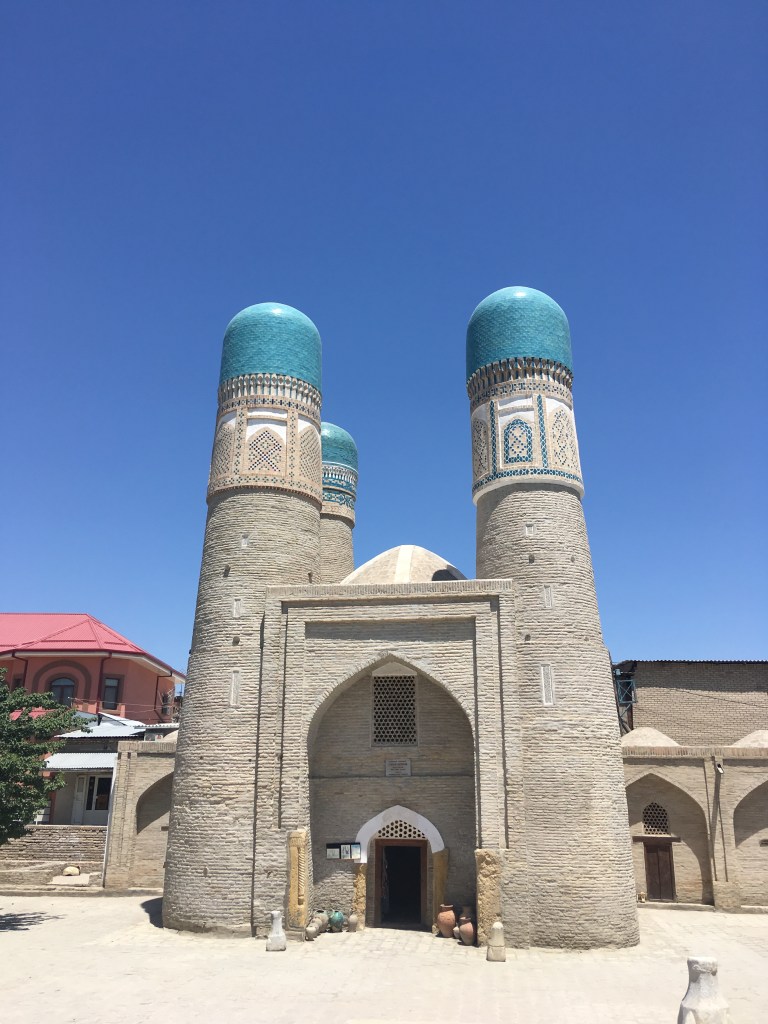
Char Minar Madrasah

Khiva- Western Uzbekistan

After spending time in Tashkent, we took a domestic flight to Urgench, on the other side of the country. The domestic airport in Tashkent was small but I loved the 1960s feel, which felt like airports in the Sean Connery-era James Bond films.

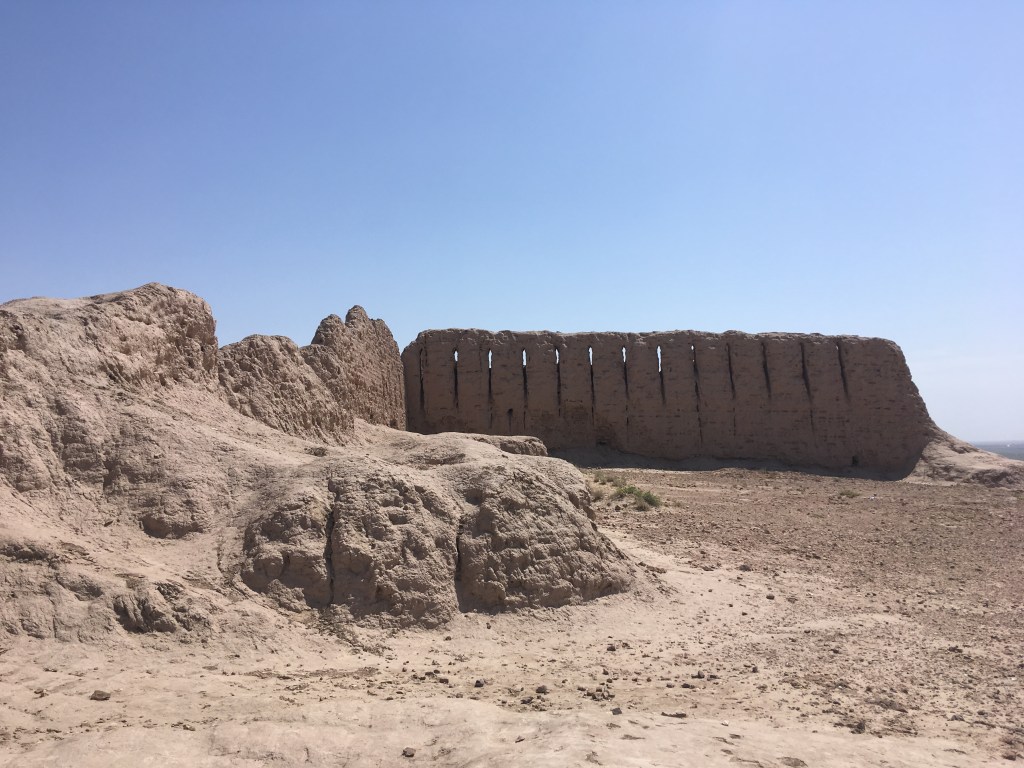
After arriving in Urgench and driving through some bumpy roads, we explored the ruins of an ancient fort. The fort is thought to be so old that it dates back to the time when Zoroastrianism was the predominant religion, predating Islam. We also passed through the Autonomous Republic of Karakalpakstan. Although mostly barren, it is home to the Karakalpak people. They have their own language which despite Karakalpakstan being in Uzbekistan, shares more similarities with Kazakh.

The ruins of Ayaz Kala, near Urgench

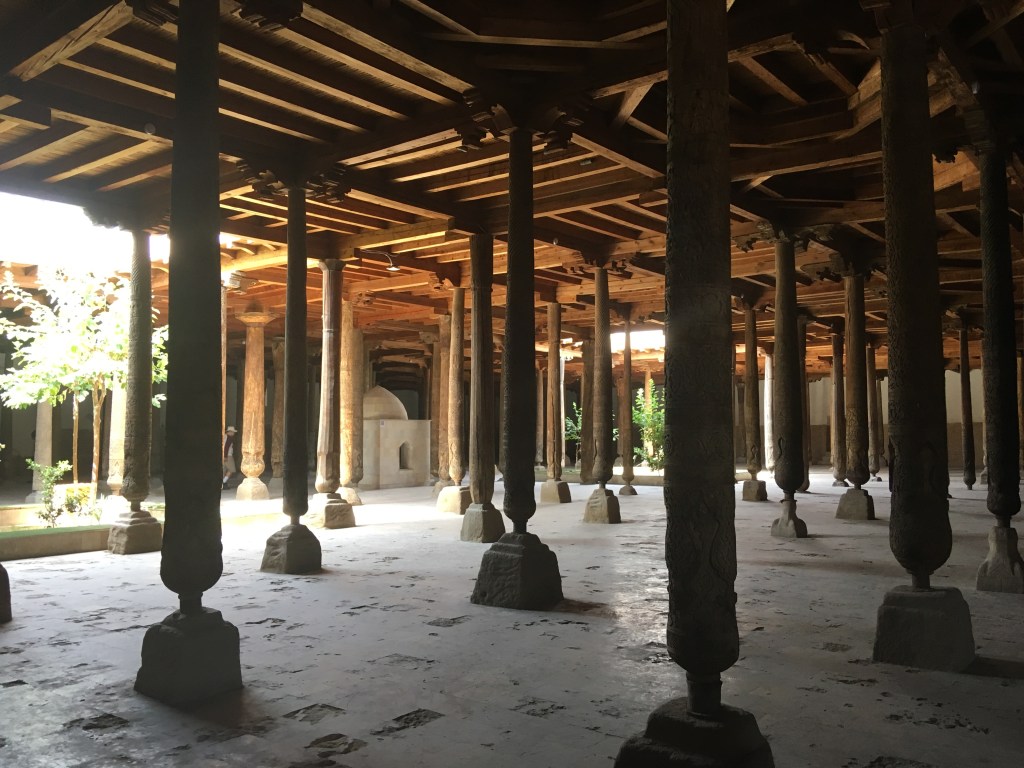
Eventually, we arrived at our next destination, Khiva. Although Khiva is a city of nearly 90,000 people, it is best known for Itchen Kala, an ancient citadel which is also a UNESCO World Heritage Site. Once inside the imposing city walls of Itchen Kala, it feels as if you are in a massive outdoor museum or a real-life Aladdin set. There are no cars, which added to the ancient feel of the city. Khiva is home to a number of mosques including the Juma Mosque, which is known for its forest of carved wooden pillars and being the place where Genghis Khan stabled his horses during his stay in the city.

Juma Mosque

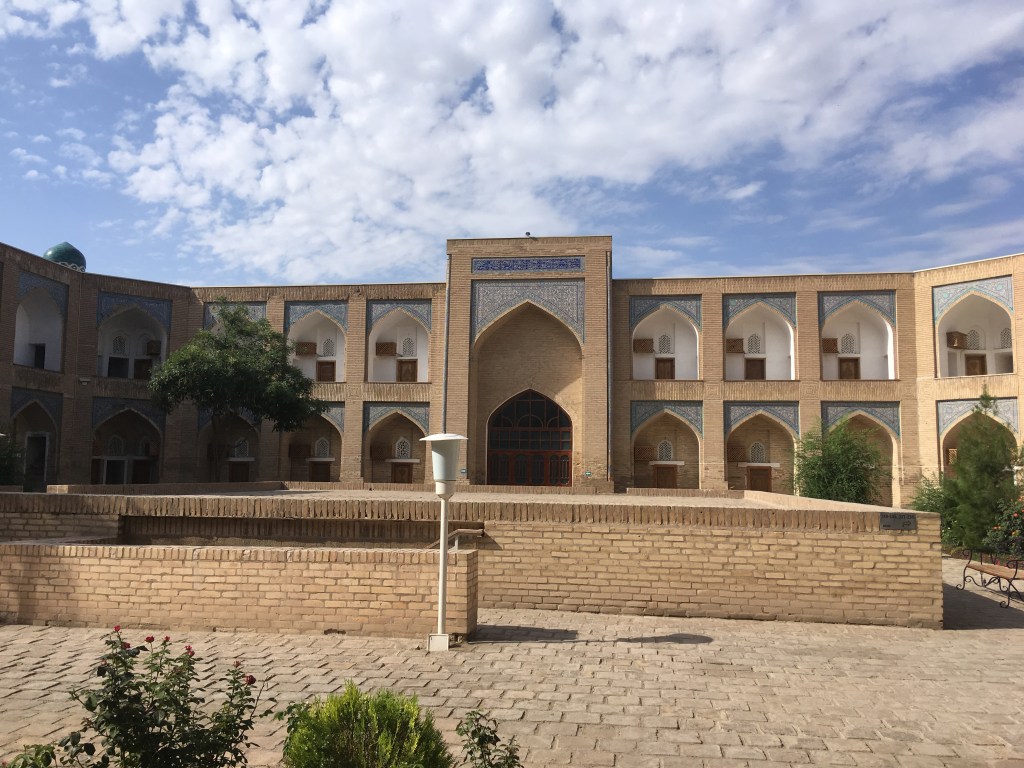
Itchen Kala has two main madrasahs (Islamic schools), the Mohammed Amin Khan Madrasah and the Mohammed Rakhim Khan Madrasah, the former of which has been converted into a luxury hotel. Both these madrasahs are elaborately decorated and were important in educating the next generation in the ways of the prophet and the Qur’an.

Mohammed Amin Khan Madrasah

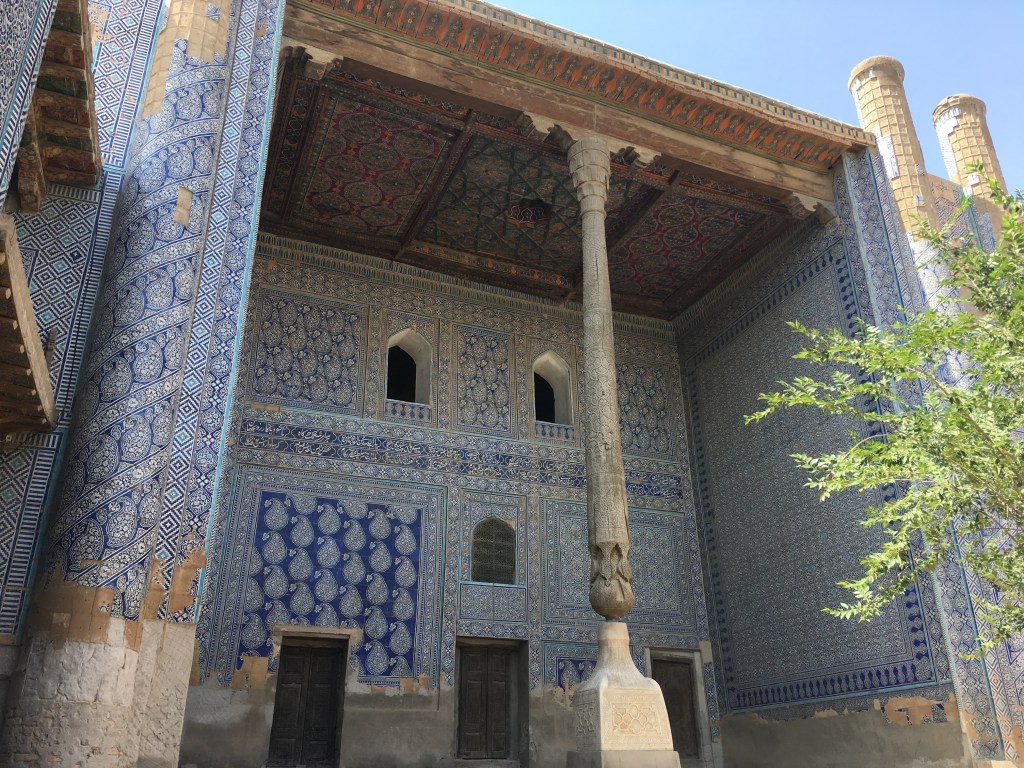
As well as being a city, Khiva was once an khanate or kingdom. The Khan of Khiva once lived in the Tosh-Khovli palace, which as well a court as well as a palace. The Khan used to pass judgements on the crimes and return through one of three doors to indicate whether the defend was to be executed, incarcerated or freed. The palace was also home to the Khan’s many wives and concubines. Each woman had their own rooms and only the Khan knew the secret passageway to their living quarters, through a secret tunnel.

The three doors at the Tosh-Khovli palace

Aside from the beautiful ancient buildings, Khiva was also the first place I tried Uzbekistan’s national dish, Plov. It is a filling dish, consisting of rice, meat and vegetables and goes very well with a pot of green tea afterwards! Green tea is a popular summer drink in Uzbekistan and is often drunk out of small traditional tea bowls. Despite being a hot beverage, it is effective at cooling one down during the hot summer months.

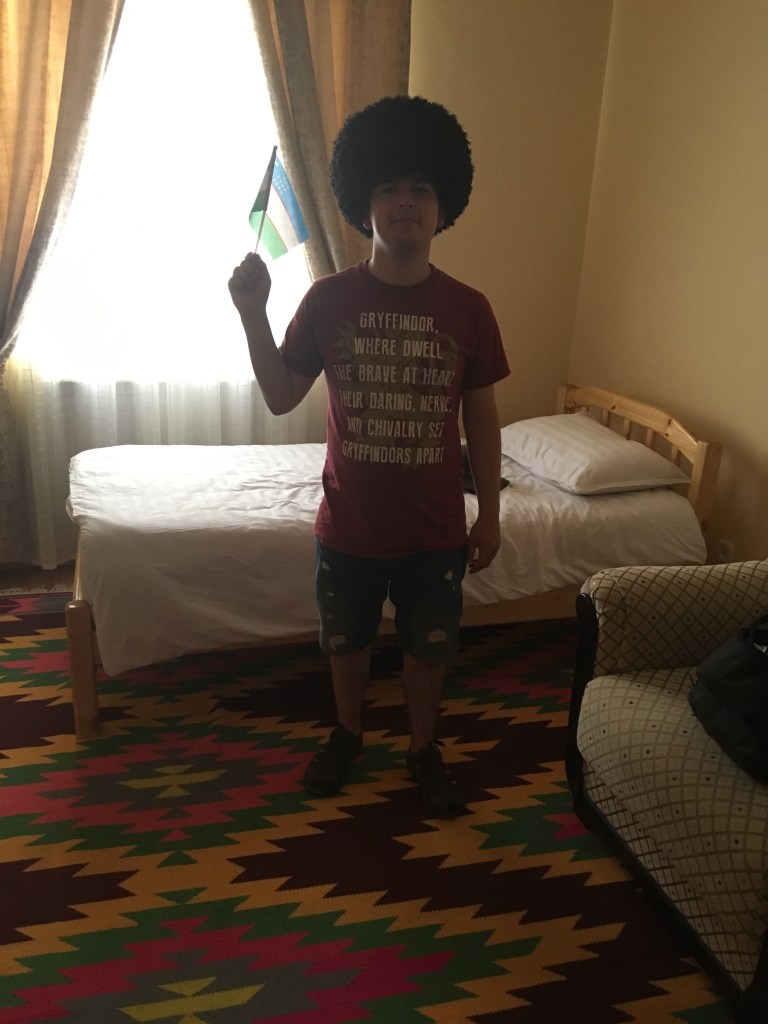
Throughout the streets of Khiva, there are various stalls selling traditional wooly hats, called Chugirmas. Although these hats are mostly made across the border in Turkmenistan due to the city’s close proximity to the border, they have also been traditionally worn in Khiva and the surrounding Khorezm Region. They have practically uses, as they keep the wearer as warm in the winter and cool in the summer. It was also used by travellers as a pillow whilst sleeping, due the hat’s soft, wooly texture.

Picture of me wearing my Chugirma
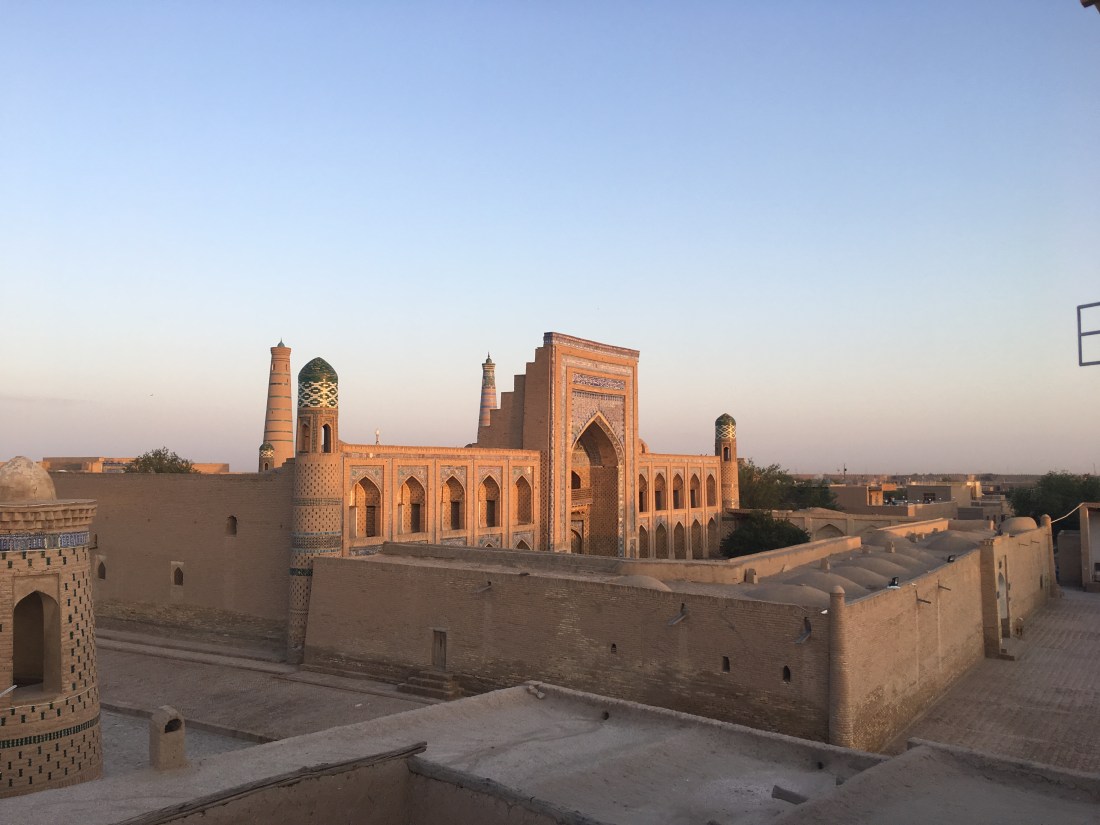
Khiva at sunset

After our fascinating stay in Khiva, we boarded an six-hour train eastwards across the desert to Bukhara.

Tashkent – a reflection

With the world in lockdown due to Covid-19 and a whole host of events and travel cancelled, I have decided to blog about my family’s trip Central Asia last July. It is a fascinating region that is not often spoken about in the Western World and an area of mystery to many. We visited three countries on our trip: Uzbekistan, Kazakhstan and Kyrgyzstan. After finishing my university exams and dissertation, my Mum suggested I read a book she had read called ‘Sovietstan’ by the Norwegian Erika Fatland. After reading the book, this made me reflect on my own visit to Central Asia. In this blog, I will talk about Tashkent and discuss the other destinations in subsequent blogs.

Getting to Uzbekistan is surprisingly easy, as we flew from Edinburgh to Tashkent with Turkish Airlines via Istanbul. The airport in Istanbul is perhaps one of the biggest terminals I have ever seen in my life and our flight was delayed, triggering a slight panic at the terminal. Luckily, we did not have too far to walk to get to our connection. Our connecting flight was by far the most bizarre flight I have ever been on in 21 years of flying and we were practically the only non-Uzbek passengers on the plane. The Uzbek passengers all carried huge amounts of hand luggage, from huge wheelie cases designed to go in the hold, to plastic bags filled with all sorts of goods from books to washing powder and baby nappies. Once on the plane, it became a scrum of different people constantly swapping seats to sit next to their family and friends and people struggling to squash as much hand luggage as they could into the overhead bins, much to the frustration of the flight attendants. One Turkish flight attendant told us that these types of scenes were an everyday occurrence on the Istanbul-Tashkent flight!

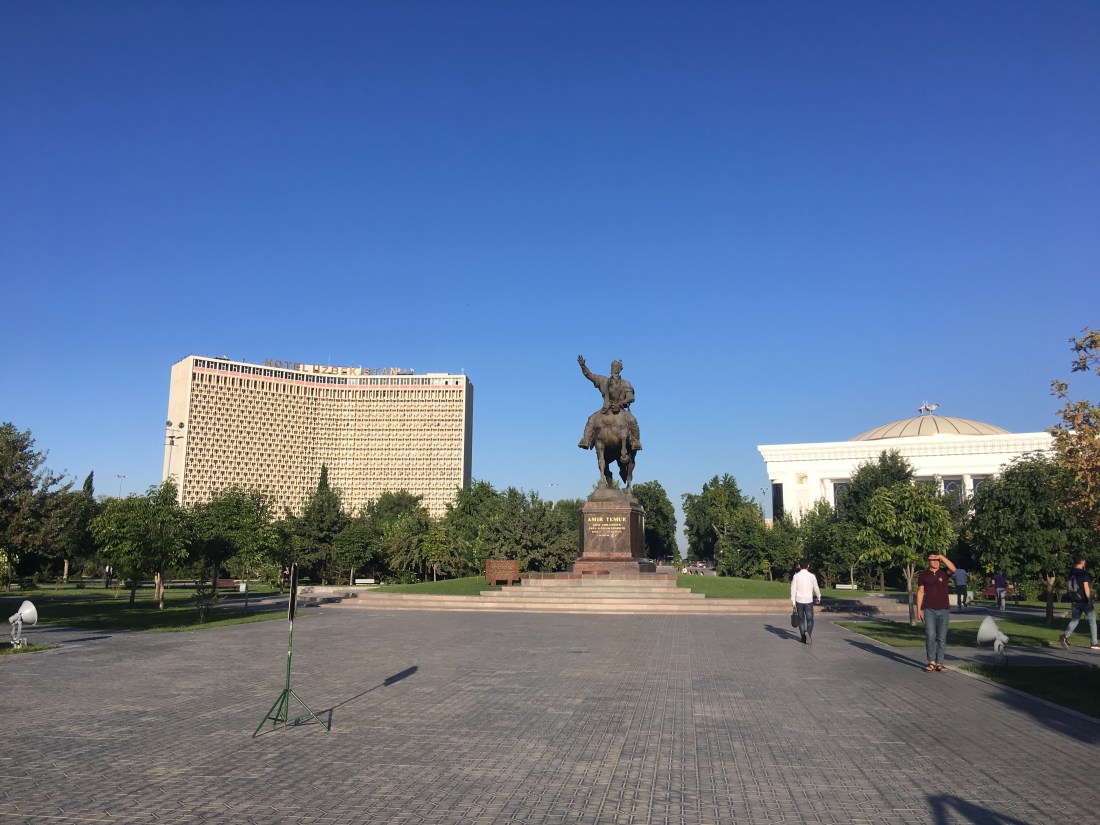
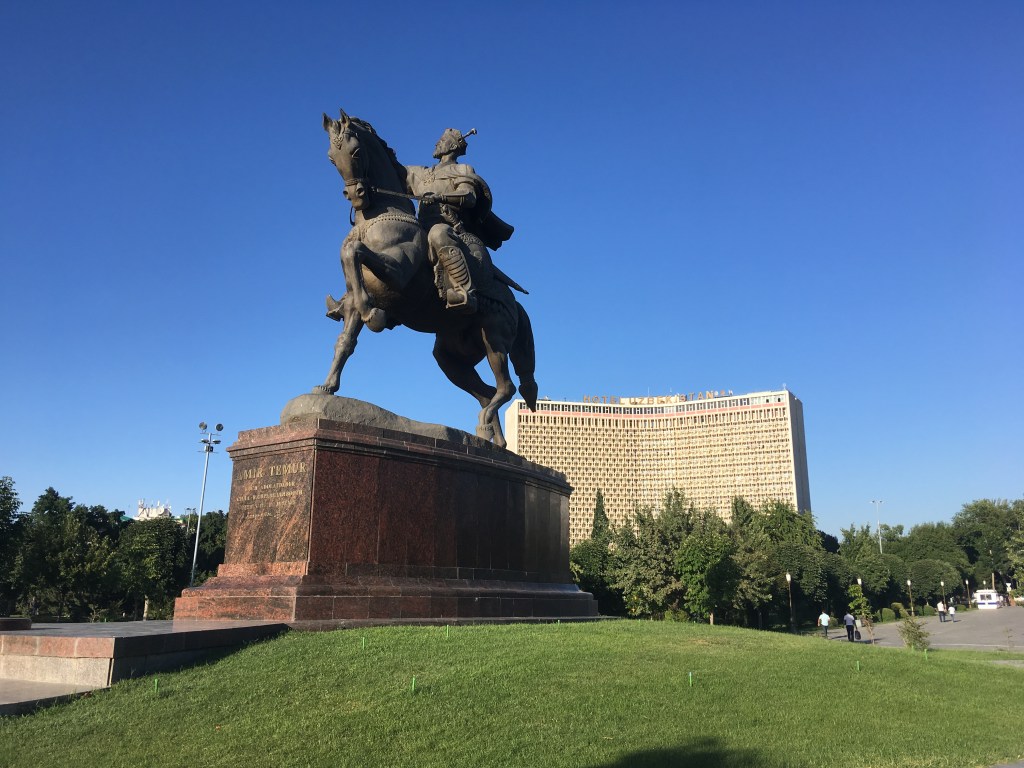
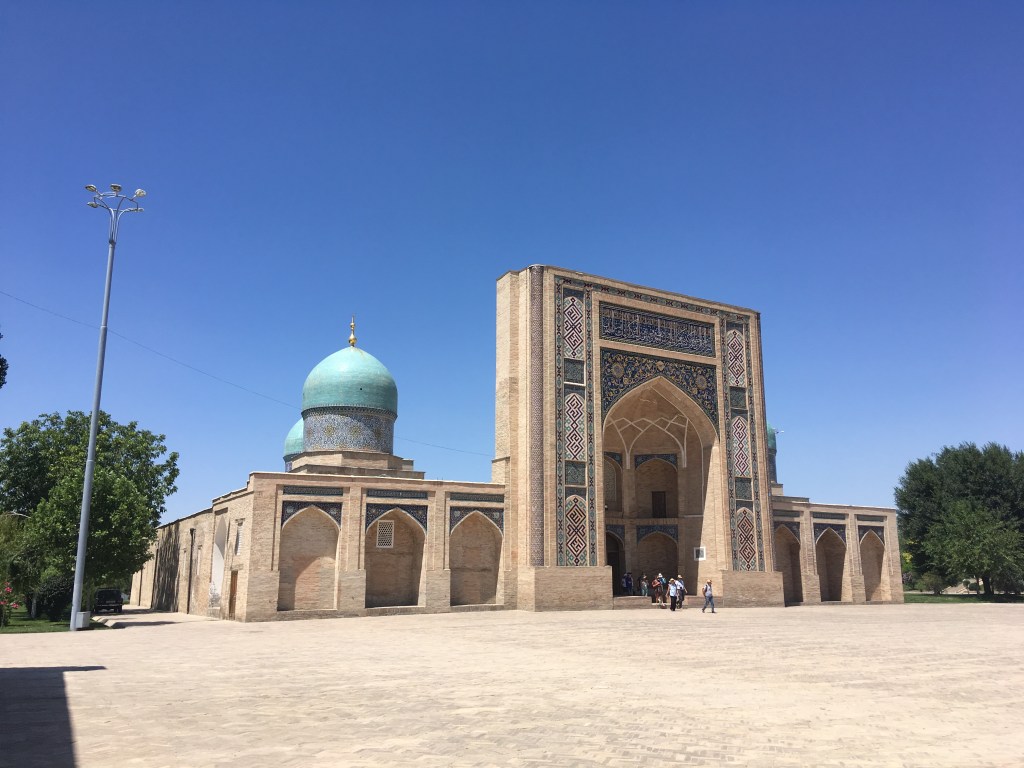
Once we arrived in Tashkent, it appeared to be very similar to watching old films of the Soviet Union. There were the grand boulevards, rows of Soviet-style apartment blocks and 1970s Soviet Lada and Vaz cars. However, Tashkent is a fun and vibrant city. Amir Temur Square, overlooked by the Hotel Uzbekistan is very impressive and a nice place for a walk and talk in the hot sun. In the middle of the square, there is a towering statue of Amir Temur (frequently known as Tamerlane in the West), who is a national hero in Uzbekistan. As well as Soviet architecture, Tashkent is home to some beautiful Islamic architecture, including the old Barak-Khan Madrasah, a madrasah being an Islamic school. Near the madrasah, there was a library which housed one of oldest Qur’ans in the world. Thought to have originated in Samarkand in either the 8th or 9th centuries, it was very large and featured a style of Arabic script that is no longer used or understood by many.

Amir Temur Square, with the Hotel Uzbekistan in the background

Tashkent is also home to a number of museums dedicated to the history, art and culture of Uzbekistan. The museums housed a plethora of carpets, suzanis and paintings from various eras of history and gave us a flavour of the richness of Uzbek culture. In the past, Uzbek art was often present in other parts of the world due to Uzbekistan being in the middle of the Great Silk Road.

Barak-Khan Madrasah

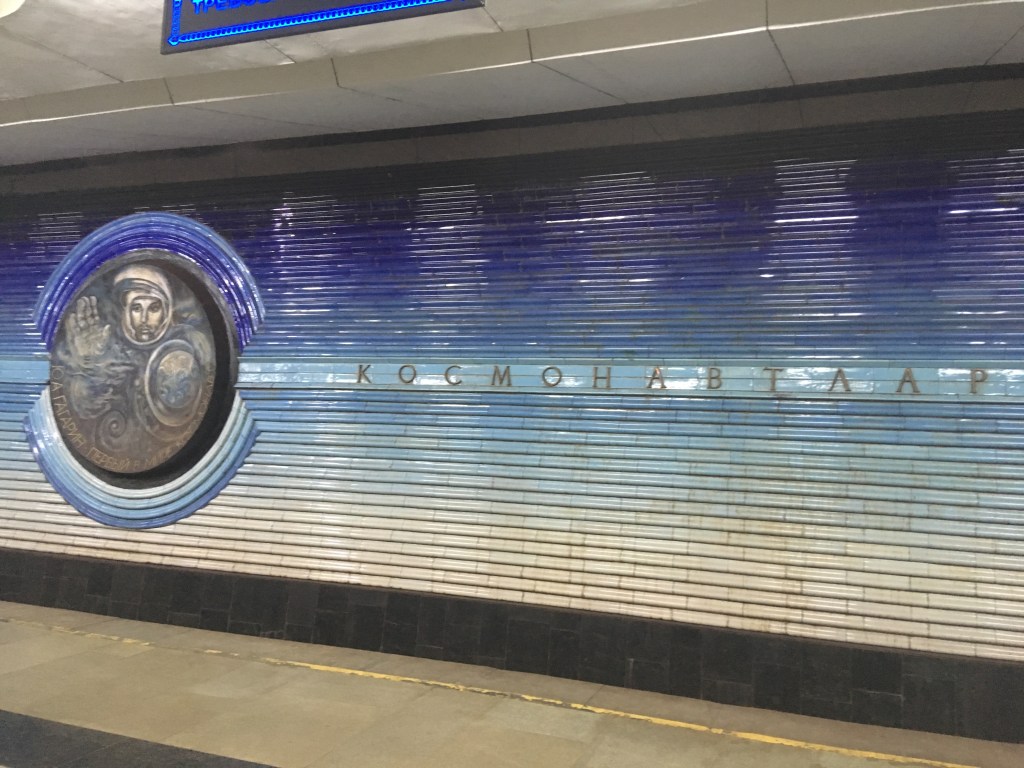
My personal favourite aspect of Tashkent was its metro system. It is very cheap, with one ride costing only 1,200 Uzbek Soms (10p GBP or 15¢ USD). It is also very easy to navigate the system as tokens are used as opposed fancy prepaid cards or tickets, and there are only three lines which at the same time, cover most of the city. Unlike London, Paris and New York City where underground stations are often dirty and plastered with adverts peeling off the walls, stations in Tashkent are decorated with art and each station has its own separate theme. For example, the station ‘Kosmonavtlar’ (Космонавтлар in Russian) is space themed with portraits of the well-known Soviet cosmonauts including the first woman in space, Valentina Tereshkova and the first man in space, Yuri Gagarin on the walls. Although considerably smaller than most underground networks I have travelled on (albeit bigger than Glasgow!), Tashkent has to be one of my favourite, if not my favourite underground system in the world.

Kosmonavtlar Metro Station

After spending two days in Tashkent we made to our way to the airport to fly to Urgench in the west of Uzbekistan. From then on, we would travel by road to the ancient city of Khiva.