
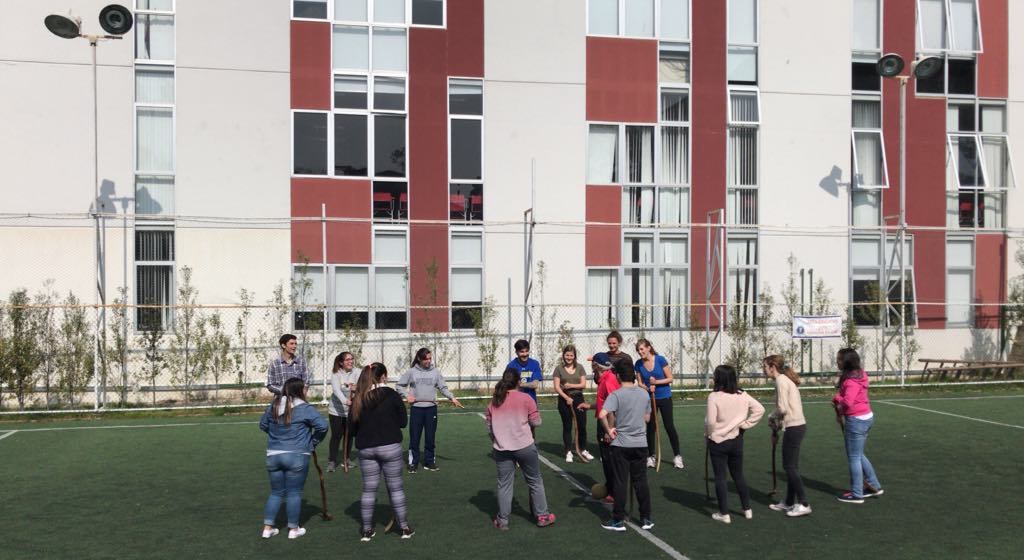
This week we had our first practical class for Mapuche Games, which took place on the university pitch in Viña del Mar. There, we were introduced to the game of Palín.
Palín is one of the games played by the Mapuche in order to settle disputes between tribes. It is widely regarded as one of the pillars of Mapuche culture and much of the terminology used in class is in Mapudungun, the language of the Mapuche. The sport is similar to hockey and shinty and is played with a stick called a ‘weño’ and a ball called a ‘palí’. Teams normally consist of about fifteen players each side and both teams try to take the palí to the other end in order to score a ‘tripay’. The pitch is rectangular and is called a ‘palíwe’.
Unlike most sports such as hockey and shinty, in palín, players begin the match facing each other horizontally in a line across the pitch. A player’s opposite number is called ‘kon’ and they are supposed to be mindful of their opposite number’s family. The game begins when the two captains (always the players in the middle of the line) come out and touch palís four times to the count of ‘kiñe, epu, güla, meli’ (one, two, three, four in Mapudungun) and compete for the palí, much like a bully-off in hockey or a face-off in ice hockey.
Due to the small size of the university pitch, the number of players on each team was seven and we had to take turns to play as the class is quite large. The game could be quite competitive and games frequently turned into a maul of players all swinging their weños trying to get the palí. Due to some of the viciousness, I believe it would be banned in the UK due to health and safety reasons! I was in a team of seven alongside Holly and Charlotte, my classmates from Heriot-Watt. We played very well as a team and eventually won our game 2-0.
The lesson was a fantastic introduction to the game of Palín and I look forward to our next class next Tuesday with the great excitment. We all said to each other at the end that it was like nothing we have ever done before and that it was great to try something new and learn about a completely new culture.
Mari Mari!
(Photo credits go to Holly)
 Hugh's Voyages and Discoveries