FC Basel vs BSC Young Boys

Sundays in Mulhouse can be dull, as apart from McDonald’s, Starbucks, and a small Carrefour market in the centre of town, virtually everything is closed. I decided to look at the FC Basel fixture list and saw there was a home game against Young Boys, a team from from Bern. After the fun I had going to Everton de Viña games in Chile, I knew I had to make the most of my Sunday and get a ticket.

After I bought my ticket, which was an e-ticket in order to avoid the 10 CHF handling fee, I found out that FC Basel vs Young Boys was a highly anticipated encounter as FC Basel were second in the league with Young Boys eleven points clear at the top of the table. Despite Young Boys being knocked of the Champions League in the group stages this year, they beat Cristiano Ronaldo’s Juventus 2-1 and put up a stern fight against Manchester United at Old Trafford. It all made for a great match.

When I arrived at St Jakob-Park, the impressive home of FC Basel with a capacity of over 38,000, I immediately took advantage of something banned at football matches in Scotland and Chile, beer. In addition to this, the one thing that I noticed was that despite the availability of beer, there were far fewer fans visibly drunk than a match in Scotland or England. The beer is served in plastic tumblers and you have to remember to bring your cup back in order to get the 2 CHF pfand! (deposit)

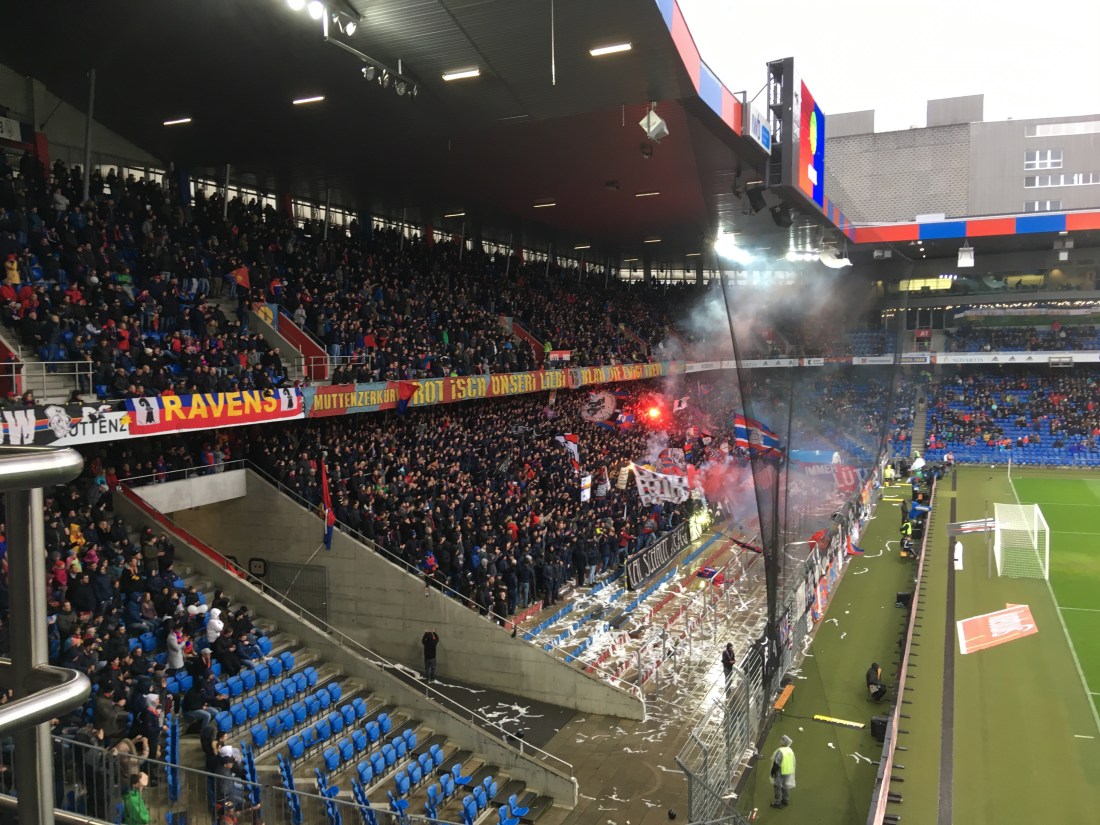
Although I was sat in one of the side stands, I was close to the FC Basel ultras who put on quite a display, featuring balloons, banners, massive flags, flares and ticker tape. On the opposite side, the Young Boys fans also set off flares and displayed a wall of yellow scarves. The electric atmosphere definitely made up for the cold wet weather.

The game did not disappoint in the slightest. FC Basel started well going 1-0 in front of a corner that went in via a deflection from a Young Boys defender. However, Young Boys piled on the pressure, took advantage of some lax Basel defending and went 2-1 up just before half time, the first goal came from a cross whilst the second came from a free kick. The best goal of the game came in the second half when Basel talisman Noah Okafor thundered home from outside the box. Both sides had chances later on to win the game but the match ended 2-2.

One thing I also loved about the experience was that public transport to and from the stadium is free, a real bonus if you are a student! In addition to the free transport, special trams were put on so supporters could get home from the ground swiftly. I think the free transport is an excellent idea, maybe Hearts should consider bringing in a similar concept?

Overall, I really enjoyed the experience of my first football game on the continent and hope to get to FC Basel’s next home game against FC Lugano, from the Italian-speaking canton of Ticino.
Everton de Viña vs Palestino

Last weekend, I attended Everton de Viña’s final home game of the season and also my last football match before I leave Chile. With relegation still a threat for El Oro y Cielo, a win and three points was vital. This week, Everton welcomed Palestino, who the week before won the Copa de Chile, beating Audax Italiano 4-2 on aggregate. 

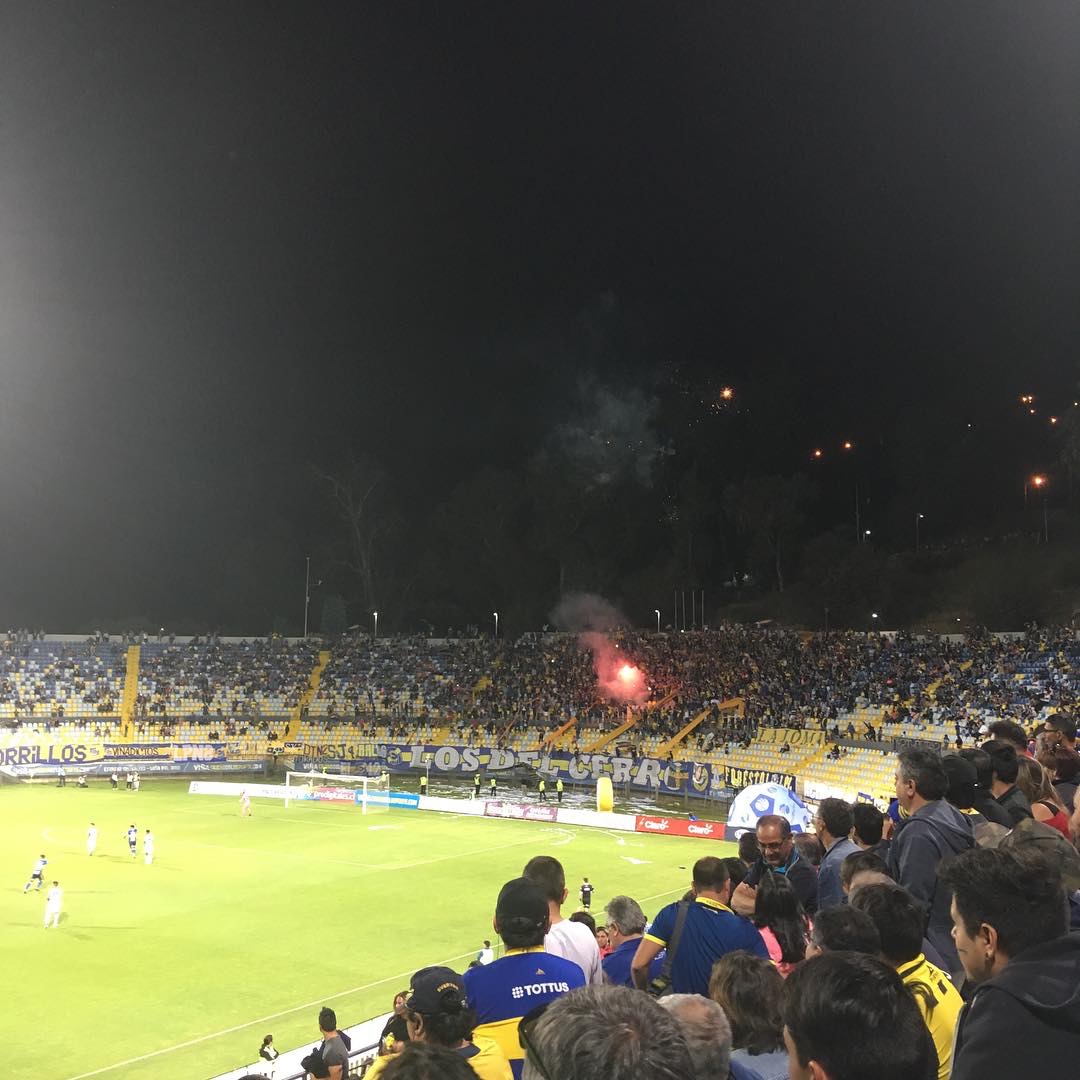
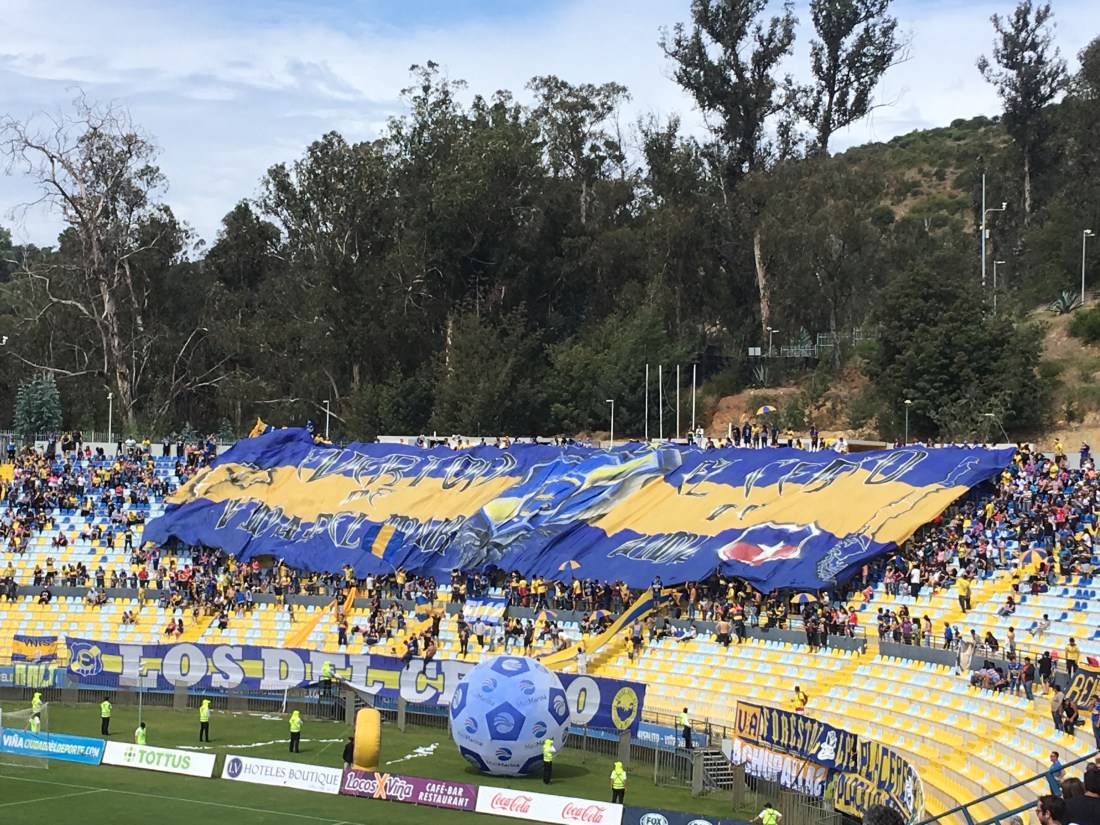
The atmosphere in the stadium was electric and there was a high turnout. For the teams coming out, everyone in the stand I was in had to hold up cards which when looking at it from the other side, would appear as blue and yellow stripes. The Everton de Viña Barra Brava, Los del Cerro was in full voice, with usual songs, chants, banners, umbrellas, drums and trumpets, combined with fireworks and ticker-tape. 

Everton de Viña dominated the game from start to finish. They got on the scoreboard early when after seven minutes, Patricio Rubio smashed the ball from the edge of the box past the goalkeeper and into the left side of the net. Everton were initially given a penalty for a handball but just before it was due to be taken, the penalty was waived on the advice of the fourth official, to the fury of the home fans.

However just before halftime, Everton de Viña were given a penalty for a handball in the box. On look at the replay, it was a harsh decision but the penalty decision stood and Cristián Suárez slotted it home to make the score 2-0 at the break. By this point, the atmosphere inside the Estadio Sausalito was positive and Los Del Cerro were in party mode.

Palestino began the second-half fired up and looking to get back into the game. However, their momentum collapsed when after 47 minutes, when Diego Orellana added Everton de Viña’s third. From that point onwards, El Oro y Cielo dominated the game and had numerous chances to add a fourth. Palestino’s evening was summed up when winger Cesár Cortés was shown a straight red card for a strike to the face on Everton de Viña’s Sebastián Leyton. When the final whistle blew, the home fans were delighted as Everton de Viña are all but safe and set to play next season in the Primera División. 

The game was my final game watching Everton de Viña and I have really enjoyed going to the games and following their season. In a week which has definitely not been the finest for South American football, the final game did not disappoint and I will remember going to watch Everton de Viña for a very long time. 


Birthday and Everton de Viña vs Antofagasta

On the 28th of October 2018, I celebrated my 20th birthday, my first celebrated outside Scotland. However, it was certainly one that I will remember for a long time.

For my birthday, I went with Holly and Charlotte to the Everton de Viña del Mar match vs Antofagasta, a team from the north of Chile. Everton de Viña are at risk or relegation this season whilst Antofagasta our competing for a spot in next year’s Copa Libertadores. (South American version of the Champions League) Therefore, everyone was in no doubt that this was going to be a hard match el Oro y Cielo. After long lines and numerous security checks, we finally got to our seats. Although slightly cloudy, it was 20 degrees Celsius and no rain was in sight- very different from compared to Scotland!

Right from the start, Antofagasta’s prowess showed when Venezuelan star striker Eduard Bello capitalised on a goalkeeping error to put the visitors 1-0 ahead. However, things to a romantic twist as during his goal celebration, he ran up to the stand and proposed to his girlfriend!

Everton de Viña later drew level 1-1 from a superb free-kick leaving the keeper frozen and later went 2-1 in front. However, they failed to hang on until the half-time whistle when Eduard Bello scored a fantastic skillful goal to make the score 2-2 at the half.

Everton de Viña were by far the better team, with more possession, passes and shots on target. However, they wasted quite a few chances and it looked progressively more likely that the match would end a 2-2 draw. Despite this, their relentless pressure soon paid off and Óscar Salinas scored the winner in 83rd minute, causing the Estadio Sausalito to erupt and Los del Cerro (Everton de Viña’s Barra Brava/Ultras) to bring out a massive banner that covered the entire end. The match ended 3-2 and Everton de Viña got an important but well-deserved three points.

After the match, the three of us headed back into the centre of Viña del Mar for the post-match pint before our meal at one of Viña’s Peruvian restaurants. It was a lovely meal and it was washed down with a Pisco Sour and an Inca Kola, one of my favourite soft drinks. What I did not realise however was that Holly and Charlotte had bought me a surprise birthday cake and given it to the restaurant before the match, which was very kind of them!

I had a great birthday and hope to get to the last Everton de Viña home game against Palestino at the end of November.

Argentina vs New Zealand- 2018 Rugby Championship

For many years whilst living in Scotland, I have seen many Rugby Championship matches on television and I have also been to a very high number of Scotland home internationals in both the Six Nations and November Test series. However, I managed to get tickets to watch Argentina play New Zealand in Buenos Aires.

The game comes with what has been a very interesting Rugby Championship. Argentina have won two games, one of which was a victory over Australia in the Gold Coast in their previous match whilst New Zealand came into the match having just lost to South Africa in Wellington, breaking a 22-game winning streak. The situation made for an exciting encounter between two top-class sides.

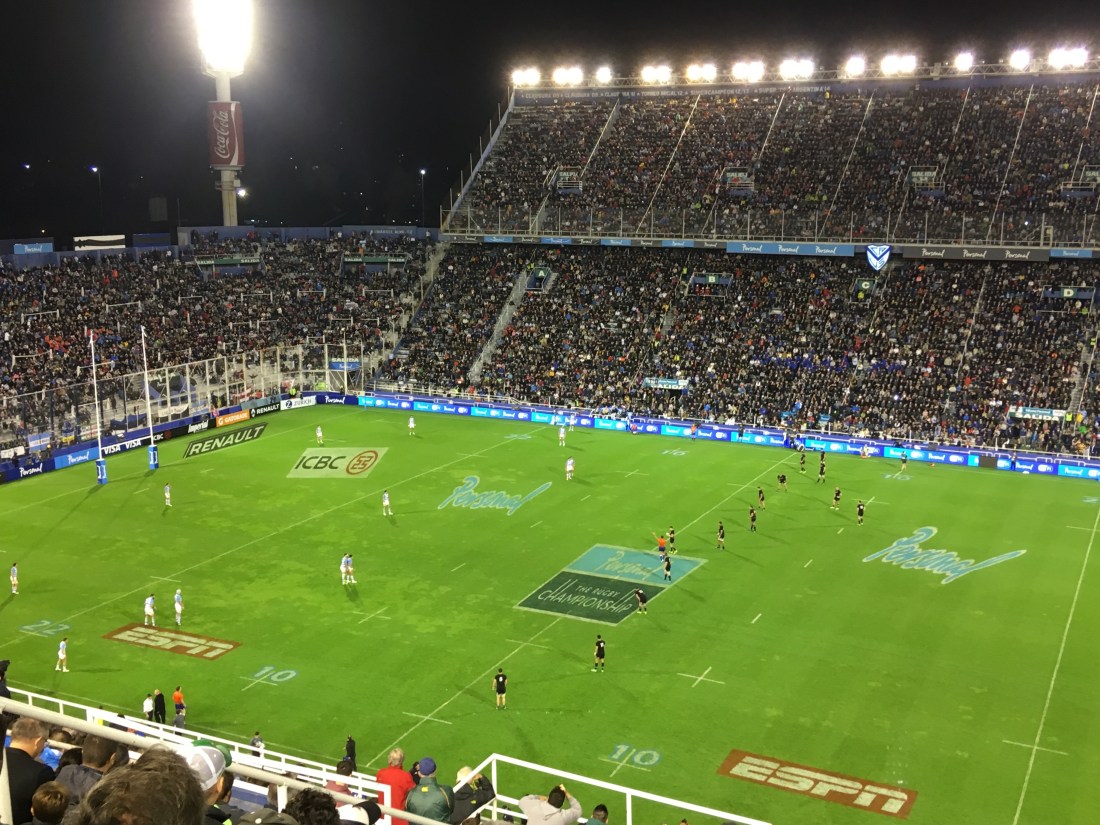
After taking the45-minutes bus journey from Palermo in centre of Buenos Aires to the outskirts on the west of the city, we arrived at the Estadio José Amalfitani, home of Vélez Sarsfield. one of Buenos Aires’ many football teams. After a slightly chaotic entrance to the ground, we made it into the stadium and we were amazed by the atmosphere and the sheer number of fans that had turned out. It was reported that the match had been sold out, even after 2,000 extra tickets were put on sale in the run-up to the match. After the singing of the national anthems and the haka, the match got underway.

Argentina played very good attacking rugby and played a similar style game to that of previous weeks, passing the ball across the width of the pitch. However, Argentina struggled with the set pieces and gave away try-scoring opportunities because of this. They also struggled defensively and missed quite a few tackles, allowing New Zealand to gain territory quickly. I do however feel that Argentina’s main issue was the number of unforced errors. They often gave away knock-ons and turnovers when they were in try-scoring positions. One example of which was a penalty in the second half when Argentina were on New Zealand’s 5 metre and fly-half Nicolas Sanchez bizarrely chose to play a cross-field kick intended for Moroni when running the ball or a scrum would have been a much better option from that position.

New Zealand played very well in the first half particularly. They soaked up quite a bit of phases but played an outstanding passing game, creating frequent overlaps allow them to tear through the Argentine defense with relative ease. New Zealand are known to be a very streetwise it was very apparent throughout the game. Although Sonny-Bill Williams was sent to the sin bin for repeated infringements in the first-half, New Zealand assumed that if they stopped Argentina both legally and illegally from scoring a try, they would eventually make mistakes, which they did. Beauden Barrett was solid between the sticks and slotted over all of his kicks, something which he has often struggled with in previous matches.

The match finished Argentina 17 New Zealand 35, but Los Pumas can take a lot of pride from the match and can hopefully build on it for their final match against Australia in Salta. New Zealand on the other hand have won their third Rugby Championship title in a row and will play South Africa away in the final round.

As someone from the Northern Hemipshere, it was an amazing experience and one of the best games of rugby I have ever attended. The quality of rugby was outstanding and the atmosphere was amazing. The matchday experience will definitely be one of the highlights of my time in South America.

Palín

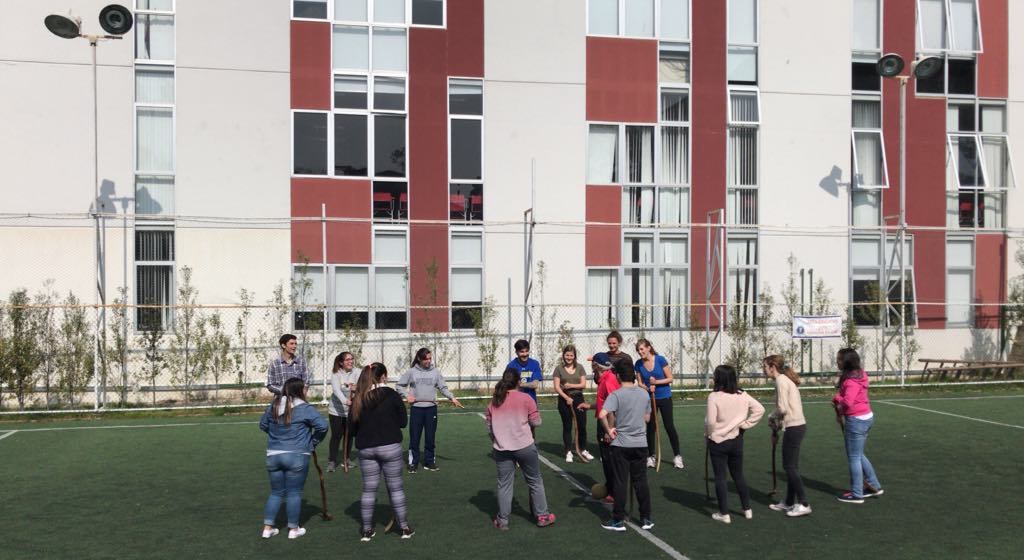
This week we had our first practical class for Mapuche Games, which took place on the university pitch in Viña del Mar. There, we were introduced to the game of Palín.

Palín is one of the games played by the Mapuche in order to settle disputes between tribes. It is widely regarded as one of the pillars of Mapuche culture and much of the terminology used in class is in Mapudungun, the language of the Mapuche. The sport is similar to hockey and shinty and is played with a stick called a ‘weño’ and a ball called a ‘palí’. Teams normally consist of about fifteen players each side and both teams try to take the palí to the other end in order to score a ‘tripay’. The pitch is rectangular and is called a ‘palíwe’.

Unlike most sports such as hockey and shinty, in palín, players begin the match facing each other horizontally in a line across the pitch. A player’s opposite number is called ‘kon’ and they are supposed to be mindful of their opposite number’s family. The game begins when the two captains (always the players in the middle of the line) come out and touch palís four times to the count of ‘kiñe, epu, güla, meli’ (one, two, three, four in Mapudungun) and compete for the palí, much like a bully-off in hockey or a face-off in ice hockey.

Due to the small size of the university pitch, the number of players on each team was seven and we had to take turns to play as the class is quite large. The game could be quite competitive and games frequently turned into a maul of players all swinging their weños trying to get the palí. Due to some of the viciousness, I believe it would be banned in the UK due to health and safety reasons!  I was in a team of seven alongside Holly and Charlotte, my classmates from Heriot-Watt. We played very well as a team and eventually won our game 2-0.

The lesson was a fantastic introduction to the game of Palín and I look forward to our next class next Tuesday with the great excitment. We all said to each other at the end that it was like nothing we have ever done before and that it was great to try something new and learn about a completely new culture.

Mari Mari!

(Photo credits go to Holly)